Why Does Viscosity Control Matter for Coatings and Inks?
Viscosity determines whether a coating applies smoothly, levels properly, or sags. It is not a fixed value: in coatings and inks, viscosity shifts with temperature, shear rate, and storage time — which is why routine viscosity testing matters.
What Problems Happen When Viscosity Is Off-Spec?
Too thin: sagging and uneven film. Too thick: poor spray, orange peel, clogged equipment. For inks, viscosity drift changes color strength and dot gain. Catching deviations before shipping is cheaper than recalls.
How Do Rotational Viscometers Measure Viscosity?
Rotational viscometers measure torque required to rotate a spindle in a sample. The resistance converts to viscosity in millipascal-seconds (mPa·s). This works for Newtonian and non-Newtonian fluids like paints and inks.
How Do I Match a Rotary Viscometer to My Testing Standards?
Match the instrument to your required standard. Three common standards prescribe different shear rates and geometries.
Which Standards Apply to Coatings and Inks?
ASTM D2196 — rotational viscometer, 0.1–50 s⁻¹, general QC
ASTM D562 — Krebs Stormer viscometer, fixed 200 rpm, KU paint consistency
ASTM D4287 — cone/plate viscometer, 12,000 s⁻¹, spray/brush simulation
ISO 2884 — cone-plate, high shear, brush/spray/roller
ASTM D2196 is commonly used for routine rheological evaluation and QC of non-Newtonian materials.ASTM D562 uses a Stormer paddle at 200 rpm to produce Krebs Units. ASTM D4287 requires a cone and plate viscometer.
Which Type of Rotational Viscometer Fits My Sample?
Choose based on sample viscosity range, shear rate, and data format. Spindle, Krebs Stormer, and cone and plate serve different purposes.
When Is a Spindle Viscometer the Right Choice?
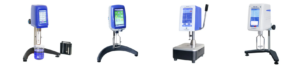
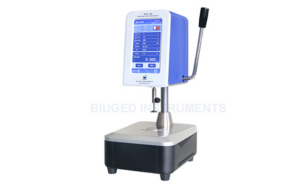
A spindle viscometer is most versatile. It accepts multiple spindles and speeds for low-viscosity resins to thick pastes. A digital rotational viscometer with interchangeable spindles is the practical starting point. Biuged’s BGD 164/165 Professional Rotary Viscometers offer multiple measurement-range configurations from 1 to 320 million mPa·s, depending on the model and range selected. BGD 164 provides stepless speed adjustment from 0.1 to 100 rpm, while BGD 165 operates from 0.1 to 200 rpm.
When Should I Use a Krebs Stormer Viscometer?
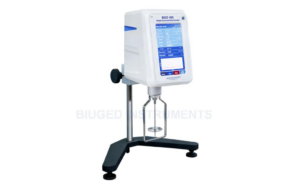
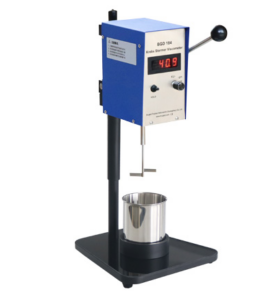
Use a Krebs Stormer viscometer when specifications require KU values. It rotates a paddle at 200 rpm and measures the load to maintain that speed. Biuged’s BGD 186 Intelligent Krebs Stormer Viscometer covers 40.2 KU to 141.0 KU with ±1.0% full-scale accuracy.
When Does a Cone and Plate Viscometer Make More Sense?
Use a cone and plate viscometer for high-shear application conditions. Spraying and brushing subject paint to shear rates far higher than a spindle viscometer can reach. It covers shear rates of 9,000–12,000 s⁻¹, meeting ASTM D4287(12,000 s⁻¹)and ISO 2884-1(9,000–12,000 s⁻¹). Biuged’s BGD 182 includes a PT100 temperature probe and stepless speed adjustment.
| Instrument | Best For | Key Standard |
| Spindle viscometer | General QC | ASTM D2196 |
| Krebs Stormer | Paint consistency | ASTM D562 |
| Cone and plate | Spray/brush simulation | ASTM D4287, ISO 2884 |
How Do I Set Spindle, Speed, and Torque for Reliable Results?
Set spindle and speed so torque falls mid-range. This eliminates the most common measurement error.
What Torque Range Should I Target?
Select the spindle and speed so that the measured torque remains within the instrument’s recommended operating range. If the torque is too low or approaches the upper limit, adjust the spindle or rotational speed and repeat the measurement. Start mid-range and adjust speed until torque stabilizes. For non-Newtonian coatings, record spindle and speed with the viscosity value.
How Do I Handle Non-Newtonian Coatings and Inks?
Run the sample at three or more speeds and plot viscosity against shear rate. Real-time sampling and stepless speed control help. Biuged’s Professional Rotary Viscometer displays viscosity changes even at low speeds.
What Smart Features Should a Digital Rotational Viscometer Have?
A digital rotational viscometer should reduce operator error and produce traceable, reproducible data.
Why Does Temperature Control Matter?
Temperature significantly affects viscosity for many coating resins — even a 1°C change can measurably shift results. Built-in temperature probes keep measurements comparable. Biuged’s Professional Rotary Viscometer includes an RTD probe; the BGD 182 uses a PT100 probe.
How Does Data Traceability Improve QC?
Traceability turns a reading into an auditable record. USB data export, calibration certificates, and user recalibration support ISO 17025-style systems. Stored timestamps and calibration history let you investigate batch deviations weeks later.
How Does Biuged Support Lab Viscometer Selection?
Biuged designs its lab viscometers around coatings and inks testing standards. The product lineup covers ASTM D2196, D562, and D4287 requirements, so customers can match an instrument to their testing protocol directly.
Which Biuged Lab Viscometer Fits Your Workflow?
General rotational testing (ASTM D2196): BGD 164/165 Intelligent Touch-screen Rotary Viscometers, 1 mPa·s to 320 million mPa·s, 7-inch touchscreen, stepper motor, magnetic spindle mounting, USB export.
Paint consistency (ASTM D562): BGD 184 Krebs Stormer Viscometer, direct KU/gram readings, magnetic rotor, calibration certificate.
High-shear simulation (ASTM D4287, ISO 2884): BGD 182 Cone-and-plate Viscometer, stepless speed, integrated temperature control.
Biuged viscometers are used in more than 80 countries and regions by coatings manufacturers and third-party testing organizations.
Conclusion: What Is the Final Buyer’s Checklist?
Choosing a rotational viscometer comes down to four decisions: standard compliance, instrument type, measurement range, and data traceability.
Confirm the standard — ASTM D2196, D562, or D4287.
Select the instrument type — spindle, Krebs Stormer, or cone and plate.
Verify measurement range covers your samples and allows 20–80% torque.
Prioritize traceability — temperature, USB export, calibration certificates, user recalibration.
Compare total cost of ownership, including spindle durability and calibration support.
For labs testing across standards, Biuged offers a coordinated lineup — BGD 164/165 for general testing, BGD 184 for KU, and BGD 182 for high-shear simulation. The right lab viscometer matches your standards, sample range, and quality system from day one.