
Understanding Why Test Conditions Matter
Coatings, inks, adhesives, and polymer materials often behave as non-Newtonian fluids. Their viscosity can change when the applied shear rate changes. This means one measurement may not fully describe how a material performs during mixing, application, or storage.
Rotational viscometers are commonly used to measure the apparent viscosity of Newtonian and non-Newtonian fluids at selected speeds with specific spindles. In coating applications, the relationship between spindle geometry, speed, and sample behavior is important for creating meaningful test results.
Before testing, we review sample conditioning steps carefully. The sample should be mixed properly, placed under suitable conditions, and tested after reaching the required state. Differences in preparation may affect the reading and reduce the value of comparisons between samples.
For quality-control teams, repeat testing is also an important part of the workflow. Multiple readings under the same conditions can help identify variations caused by operation methods or material changes. A clear testing record supports better analysis over time.
Managing Torque Range and Measurement Stability
Torque range is another factor that affects measurement reliability. When selecting testing conditions, laboratories should consider whether the sample works within the suitable operating range of the instrument. A proper range helps maintain stable readings during viscosity evaluation.
A digital rotational viscometer can support more organized testing processes by providing digital control and data management functions. Operators can record test settings, review results, and maintain consistent procedures when evaluating different coating formulations.
Speed selection should match the purpose of the test. A lower speed may help evaluate material behavior during storage, while higher speeds can provide information related to application processes. Recording speed changes allows technical teams to understand how materials respond under different conditions.
At BIUGED INSTRUMENTS, we focus on connecting measurement methods with actual laboratory requirements. With our own R&D and manufacturing capabilities, we develop viscosity testing instruments that support different laboratory applications. For OEM and customized projects, we can work with partners to discuss instrument configurations, functional requirements, and testing workflows according to specific application needs. Our approach considers instrument settings, testing procedures, and application conditions instead of viewing viscosity data as a single independent value.
Keeping Temperature and Reports Consistent
Temperature control plays an important role in viscosity measurement. Many coating materials change their flow characteristics when temperature varies. Therefore, laboratories should maintain a stable testing environment and record temperature information together with measurement results.
A repeatable method includes more than the instrument setting. Operators should also record sample information, spindle selection, speed, temperature, and testing time. These details allow different users to understand how a result was generated and provide a clearer reference for future testing procedures.
For technical and quality teams, reporting functions can improve data communication. Clear reports make it easier to compare materials, review production changes, and discuss formulation performance with different departments.
When testing systems include software support, laboratories can organize results more efficiently. Data storage and analysis functions help users review historical information and identify possible trends during product development or quality monitoring. This also supports long-term evaluation of material performance across different batches and testing periods.
Applying Rheology Analysis to Coating Development
Viscosity testing is often connected with rheological analysis. For many coatings and inks, teams need to understand shear-thinning behavior, thixotropy, or recovery after high-shear conditions. These characteristics can influence application performance.
Rotational viscometers provide a foundation for evaluating viscosity changes at different speeds and spindle conditions. By comparing values before and after specific shear processes, laboratories can gain more information about material structure and flow response.
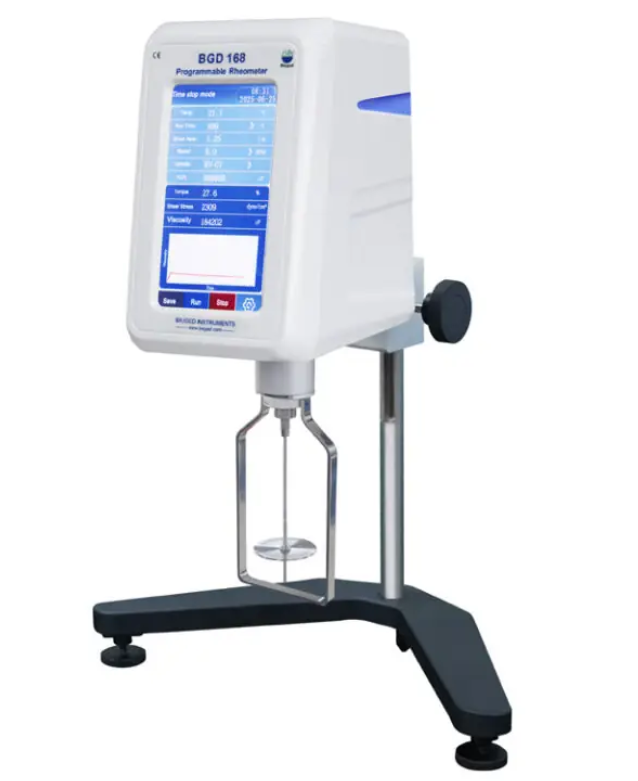
We also develop solutions for more detailed rheology studies. The Programmable Rheometer allows operators to customize testing programs, including automatic shear rate adjustments. The system can analyze material behavior through different testing procedures and help simulate practical application conditions.
BIUGED INSTRUMENTS provides testing solutions for coating, ink, and related material laboratories. Our equipment development focuses on helping users obtain stable measurement processes while supporting different testing requirements.
Building Reliable Measurement Workflows
A consistent viscosity testing workflow depends on many connected factors. Sample conditioning, torque range, repeated measurements, temperature control, and reporting methods all influence the quality of laboratory data. When these factors are managed properly, teams can create more useful comparisons.
For coating manufacturers and testing laboratories, reliable data supports better decisions during research, production control, and quality evaluation. A structured approach to measurement helps connect laboratory results with real application needs.
By combining suitable instruments with clear testing procedures, we help users build practical measurement systems. Through continuous R&D, manufacturing support, and customized cooperation options, we work with partners to adapt testing solutions for different laboratory environments. The goal is to make viscosity evaluation easier to understand and more useful for daily laboratory work.
