
Viscosity measurement plays an important role in coating and ink development. During storage, transportation, mixing, and application, materials may experience different shear conditions. These changes influence flow behavior, leveling, and final coating performance.
For R&D and QC teams, understanding rheological behavior under different shear rates helps create more suitable formulations. Small sample volume testing, temperature control, and proper cone selection are important factors when evaluating coating materials.
Understanding High-Shear Behavior in Coating Applications
Paints and inks are often treated as non-Newtonian fluids because their viscosity can change under different shear conditions. A material may show different flow characteristics when it is stored compared with when it is applied on a surface.
During storage or transportation, coatings usually experience low shear conditions. When materials are pumped, mixed, or processed, the shear level increases. These changes provide useful information for evaluating how coatings behave during production.
High-speed dispersion, rolling, spraying, and brushing create higher shear environments. In these situations, the shear rate can generally reach around 9000S⁻¹ to 12000S⁻¹. A cone and plate viscometer helps laboratories study viscosity changes under these conditions.
Selecting Test Conditions for Accurate Evaluation
Temperature has a direct influence on viscosity measurement. A small temperature change may affect the flow properties of coatings and inks. Therefore, laboratories need to consider temperature conditions when comparing different formulations or production batches.
Sample volume is another practical factor in laboratory testing. Compared with some traditional measurement methods, cone and plate structures can work with relatively small amounts of material. This can be useful during product development when available samples are limited.
Cone selection also affects measurement results. Different cone sizes and testing settings may match different viscosity ranges and application requirements. Laboratory teams should select suitable parameters according to material characteristics and testing objectives.
Connecting Viscosity Data with Product Development
Viscosity results are not only numerical values. They help coating engineers understand material behavior during manufacturing and application processes. For example, a formulation that performs well during mixing may require different flow characteristics during spraying or coating.
A cone plate viscometer can support formulation comparison by providing information about viscosity under controlled conditions. These results help R&D teams adjust components, review performance differences, and improve product development efficiency.
During formulation development, coating engineers also need to consider how viscosity changes during different production stages. A material with suitable low-shear behavior may improve storage stability, while proper high-shear characteristics can influence spraying, rolling, or brushing performance. By reviewing viscosity curves and test conditions, teams can better understand the relationship between material structure and application results. This information helps researchers adjust formulations based on practical requirements and provides QC teams with clearer references for routine inspection.
For QC departments, viscosity testing also supports production monitoring. Regular measurements allow teams to compare batches and identify possible changes in material behavior. A consistent testing process provides useful references for quality management.
Improving Laboratory Operation with Suitable Equipment
When laboratories choose viscosity testing equipment, operation convenience is also an important consideration. Clear displays, simple settings, and stable mechanical structures can help technicians complete daily measurements more smoothly.
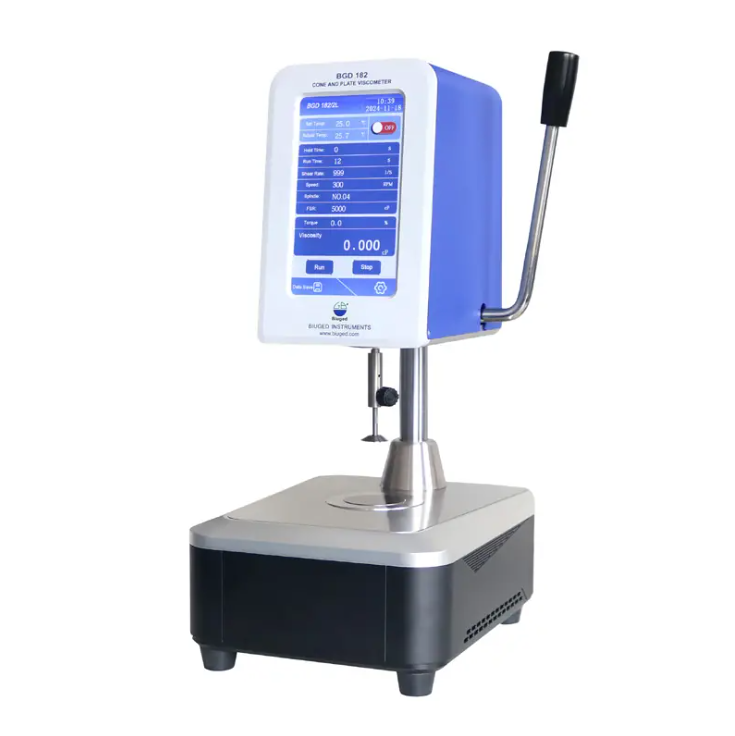
Our cone-and-plate viscosity testing solution is designed for coating and ink applications. With our own R&D and manufacturing capabilities, we develop and produce viscosity testing instruments based on different laboratory requirements. The equipment includes a 7-inch touch screen with menu operation, displaying measurement values, spindle number, speed, shear rate, and other testing information.
The system uses a durable metal shell structure with a handle for lifting and positioning. The design supports convenient operation while maintaining stable equipment performance during laboratory use.
Supporting Repeatable Testing in R&D and QC
A good testing process requires more than measurement equipment. Sample preparation, temperature control, testing parameters, and record management all influence the final results. Laboratories need to establish procedures that match their specific materials and application needs.
Our electrical system design focuses on precision, stability, and ease of operation. These features support coating companies and testing laboratories when they conduct viscosity evaluations for different materials.
BIUGED INSTRUMENTS develops testing equipment for coatings, inks, and related industries. Supported by our R&D and manufacturing experience, we provide standard instruments as well as customized solutions for different laboratory applications. For OEM cooperation, we can discuss equipment configuration, functional requirements, and testing workflows according to users’ validation needs. We focus on practical laboratory requirements and provide solutions that connect measurement technology with real testing processes.
Building Better Material Analysis Methods
As coating formulations continue to develop, viscosity analysis becomes an important part of understanding material performance. High-shear measurement can provide additional information about how coatings respond during application processes.
A cone and plate viscometer provides a testing approach for evaluating coating behavior with controlled shear conditions. Combined with suitable temperature settings and cone selection, it helps laboratories build more complete evaluation methods.
For manufacturers, accurate viscosity data supports decisions in formulation adjustment and production control. For research teams, it provides references when comparing new materials or improving existing products.
BIUGED INSTRUMENTS continues to support coating and ink industries through precision testing instruments and application-focused solutions. By combining practical design with testing experience, we help laboratories organize viscosity measurement processes that match their development and quality requirements. A cone plate viscometer can become a useful tool for teams seeking clearer understanding of material flow behavior and application performance.
