
Paint viscosity is not a fixed value during production and application. Different stages, including storage, transportation, mixing, spraying, and coating, can create different shear conditions. Understanding how coatings respond under various shear rates helps R&D and quality control teams evaluate formulation performance more accurately.
For paint and ink manufacturers, viscosity testing is not only about obtaining one measurement value. Temperature control, test conditions, repeatability, and reporting methods all influence the interpretation of results. A suitable testing approach helps laboratories better understand material behavior during practical use.
Understanding Shear Rate Changes in Paint Testing
Paints and inks are often considered non-Newtonian fluids because their viscosity characteristics can change under different shear rates. During storage or transportation, materials usually experience low shear conditions. These conditions may influence leveling and sagging behavior after application.
When materials are pumped, mixed, or processed at moderate speeds, they enter medium shear conditions. These changes can affect flow behavior and application performance. Therefore, laboratories need testing methods that can simulate different working situations.
During high-speed dispersion, rolling, spraying, and brushing processes, coatings may experience higher shear conditions. The shear rate can generally reach around 9000S⁻¹ to 12000S⁻¹ in some application processes. A cone and plate viscometer helps measure viscosity behavior under these higher shear conditions and provides useful data for formulation analysis.
Planning Test Conditions for Reliable Results
A viscosity test requires careful planning before measurement begins. Temperature is an important factor because coating materials may show different flow characteristics when environmental conditions change. Laboratories usually need to maintain consistent temperature conditions to improve comparison between different tests.
The selected shear rate should also match the purpose of evaluation. A test for storage stability may focus on different conditions compared with a test for spraying performance. Defining the application scenario helps teams choose suitable measurement settings.
A paint viscosity tester can support coating laboratories in evaluating viscosity characteristics under controlled conditions. When combined with proper test procedures, it allows technicians to collect data that can support product development and quality inspection.
Comparing Different Viscosity Measurement Methods
Different viscosity measurement methods provide information from different perspectives. Traditional viscosity tests may be useful for general quality checks, while shear-dependent measurements help explain how coatings behave during processing and application.
For paint manufacturers, combining different measurement methods can provide a more complete understanding of formulation performance. A single viscosity value may not fully describe how a material flows during mixing, spraying, or coating.
The cone and plate method offers advantages when laboratories need to study viscosity changes under controlled shear conditions. It provides a closer reference to some practical application processes and helps researchers analyze material behavior in more detail.
Improving Measurement Operation and Data Reporting
Reliable viscosity evaluation depends on both measurement accuracy and proper documentation. Repeatability is also an important factor because laboratories need to obtain comparable results when testing different batches or adjusting formulations. Consistent sample preparation, temperature control, and measurement settings help reduce operation differences between tests. Laboratories should record important testing information, including temperature, spindle or measuring system details, speed, shear rate, and final values. Clear reports make it easier to compare results between different batches.
Equipment operation also affects testing efficiency. Simple interfaces and stable structures can help technicians complete daily measurement tasks more smoothly. This is especially useful for laboratories that perform repeated tests for multiple coating samples.
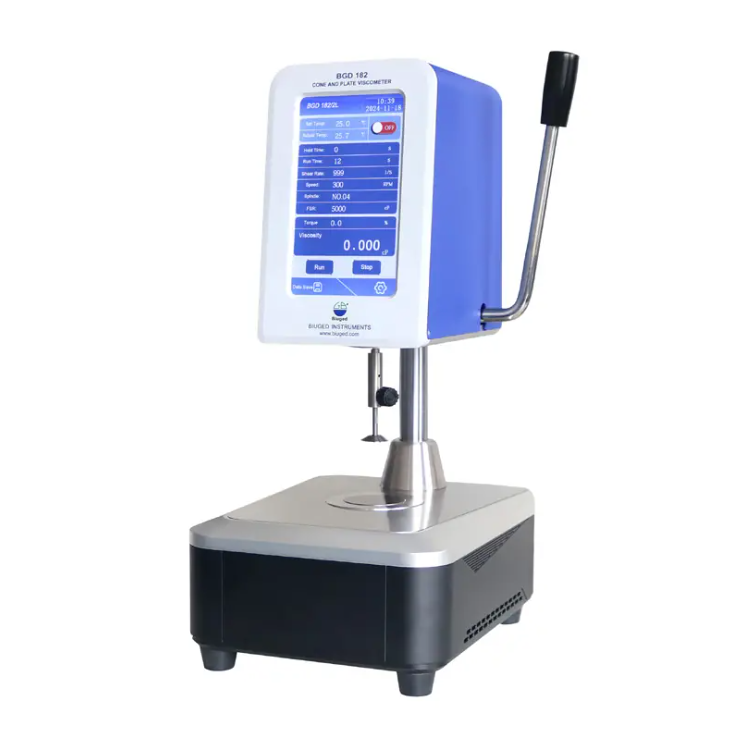
Our paint viscosity tester solution is designed for professional coating and ink testing environments. The equipment features a 7-inch touch screen with menu operation, allowing users to view measurement values, spindle numbers, speed, shear rate, and other testing information during operation.
Applying Equipment Features to Laboratory Needs
When selecting viscosity testing equipment, laboratories often consider operation convenience, measurement stability, and application requirements. Different coating types may require different evaluation methods, so equipment flexibility is an important consideration.
Our cone-and-plate viscometer is developed for coating and ink testing applications where shear-related viscosity data is needed. The system uses a durable metal shell design and a lifting handle structure, which supports precise positioning during operation.
The electrical components are carefully designed to provide stable performance during testing. These features help technicians manage regular measurement tasks while maintaining consistent operating procedures in laboratory environments.
BIUGED INSTRUMENTS focuses on precision testing equipment for coatings, inks, and related materials. With our own R&D and manufacturing capabilities, we design and produce laboratory instruments for viscosity evaluation, material performance testing, and quality control processes. Besides standard equipment, we also support customized solutions and OEM cooperation according to different application requirements, including instrument configuration, testing functions, and workflow needs.
Building Better Coating Evaluation Processes
Viscosity testing plays an important role in understanding how paints and inks perform from production to final application. By considering shear rate, temperature, repeatability, and reporting methods, laboratories can create more meaningful testing procedures.
A cone and plate viscometer provides support for studying coating behavior under different shear conditions. It complements other viscosity measurement methods and helps teams analyze material characteristics beyond basic measurements.
With experience in coating and material testing, BIUGED INSTRUMENTS continues to support laboratories that need practical testing approaches. Through suitable equipment selection and structured testing methods, companies can improve their understanding of coating performance and make better decisions during formulation development and quality management.
