
Materials used outdoors experience sunlight, heat, moisture, and changing weather. These conditions can contribute to fading, cracking, gloss changes, discoloration, or shifts in physical properties. Laboratory exposure tests help manufacturers compare material performance under controlled conditions and guide product development and quality checks.
Equipment selection involves more than comparing product names and prices. UV test chambers, xenon weathering chambers, and climate cabinets reproduce different conditions, so selection depends on the material, the failure mode, and the applicable test method.
This guide outlines the questions to ask before purchasing weathering test equipment, how the main chamber types differ, and which specifications deserve closer review.
What Should You Consider Before Choosing a Weathering Tester?
Start with the test objective, the material being evaluated, and the standard or internal procedure your laboratory needs to follow. These details help define which exposure functions are necessary.
What Material and Weathering Damage Do You Need to Evaluate?
List the material types and the changes you want to measure. A coatings laboratory may track color difference, gloss retention, or surface cracking. A plastics team may look for discoloration, brittleness, or changes in mechanical performance. Rubber, textiles, sealants, and composite materials can have different sensitivities to light, temperature, and moisture.
Before comparing equipment, clarify the following:
- Material and specimen format: coatings on panels, molded plastic parts, rubber samples, textiles, or another substrate.
- Target change: appearance, surface condition, mechanical properties, or a combination of measurements.
- Expected environment: direct sunlight, moisture, heat, condensation, or changing temperature and humidity.
- Assessment plan: visual inspection, instrumental measurement, or physical testing before and after exposure.
A defined objective helps avoid paying for functions that the test does not require, while making it easier to identify any missing capability.
Which Testing Standard and Exposure Conditions Apply?
Check the method before selecting a chamber. ASTM G154 addresses exposure using fluorescent ultraviolet lamps, while ASTM G155 covers xenon-arc light exposure. For plastics, ISO 4892-2 concerns xenon-arc sources and ISO 4892-3 concerns fluorescent UV sources. The standards describe different procedures, so they should not be treated as interchangeable.
Depending on the method, relevant conditions may include irradiance, lamp or filter type, specimen temperature, relative humidity, condensation, spray cycles, and exposure duration. Confirm the required values and control approach against the current standard and your laboratory procedure.
Accelerated tests can help compare materials under selected conditions, but exposure hours should not be converted directly into a fixed number of outdoor service years without a validated correlation for the material and environment.
What Is the Difference Between UV, Xenon, and Climate Chambers?
The main difference is the environmental condition each instrument is intended to reproduce. UV chambers focus on fluorescent ultraviolet exposure, xenon chambers use xenon-arc light with appropriate filters, and climate cabinets control temperature and humidity when a specified light source is not the primary requirement.
When Should You Choose a UV Test Chamber?
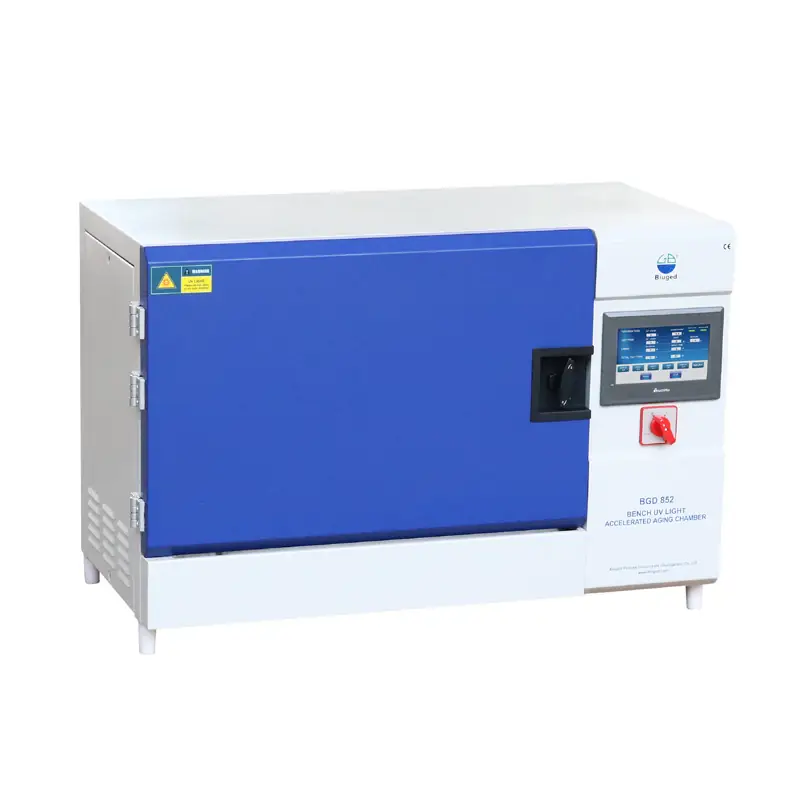
A UV testing machine may fit a procedure that investigates degradation caused by fluorescent ultraviolet radiation, often combined with moisture or condensation cycles. This approach can be relevant when the test method specifies UV lamps rather than a xenon-arc source.
Lamp selection matters. UVA and UVB lamps have different spectral outputs and can produce different material responses. A lamp that speeds up visible changes is not automatically suitable for every application, so check the lamp type against the intended method. ASTM G154 is a useful reference when planning fluorescent-UV exposure.
When comparing a UV test chamber, review lamp options, temperature control, condensation or spray functions, specimen capacity, and programmable cycles. Confirm the exact operating range and configuration for the model being quoted rather than assuming that all UV chambers include the same features.
When Is a Xenon Weathering Chamber the Right Choice?
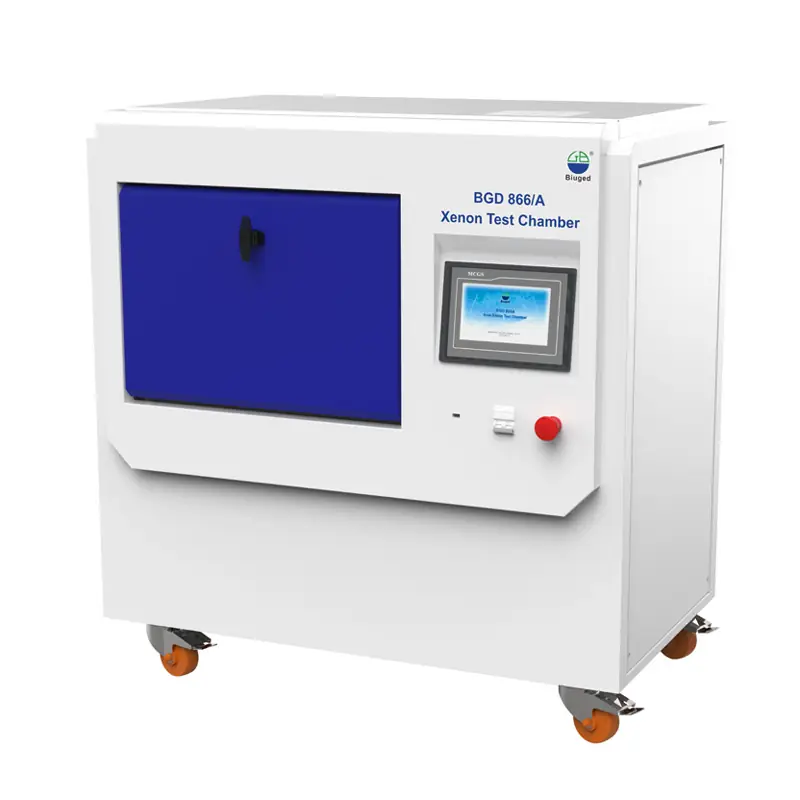
A xenon weathering chamber may be appropriate when a method calls for xenon-arc exposure intended to reproduce selected aspects of sunlight. Depending on the equipment configuration, the test may also involve temperature, humidity, and water spray.
Filters affect the spectrum that reaches the specimens, so the selected filter and exposure conditions should follow the test method. Xenon systems can be used to study changes such as fading, gloss variation, and surface damage in materials exposed to light, but the test setup should reflect the application being evaluated.
For a xenon chamber, compare the lamp and filter configuration, irradiance measurement and control, specimen temperature, humidity and spray functions, specimen loading, and data or program controls. ASTM G155 provides a reference for xenon-arc exposure methods.
When Do You Need a Climate Cabinet Instead?
A climate cabinet is worth considering when the main objective is to control temperature and humidity rather than expose specimens to a specified artificial light source. It can support conditioning and environmental tests where these variables are central to the procedure.
Do not assume that a climate cabinet provides UV or xenon exposure unless those functions are explicitly listed for the proposed model. A laboratory may need separate equipment for climate conditioning and photodegradation studies, depending on the test plan.
Check the temperature and humidity ranges, uniformity information, control functions, usable chamber volume, and specimen layout. The values should match the method and sample load that your laboratory expects to use.
Which Weathering Test Equipment Fits Your Laboratory Requirements?
Compare equipment against a written checklist rather than relying on broad category descriptions. A structured comparison helps identify whether a quotation includes the functions your method calls for.
How Should You Compare Irradiance, Temperature, Humidity, and Spray Controls?
Use the following table as a starting point when reviewing supplier proposals. The exact values should come from your test method and the supplier’s confirmed technical documentation.
| Equipment type | Typical testing focus | Items to verify |
| UV test chamber | Fluorescent UV exposure, often with moisture cycles | Lamp type, cycle settings, temperature, condensation or spray |
| Xenon weathering chamber | Xenon-arc exposure with a selected filter and test cycle | Filter, irradiance control, specimen temperature, humidity, spray |
| Climate cabinet | Controlled temperature and humidity conditions | Operating ranges, uniformity, usable volume, program control |
Consider maintenance, lamp replacement, calibration, water quality where relevant, operator training, and service availability, as these affect long-term operating effort.
How Can BIUGED INSTRUMENTS Support Your Equipment Selection?
BIUGED INSTRUMENTS lists several categories for weathering-related laboratory work. Start by reviewing its weathering test equipment range to compare the categories with your test objective.
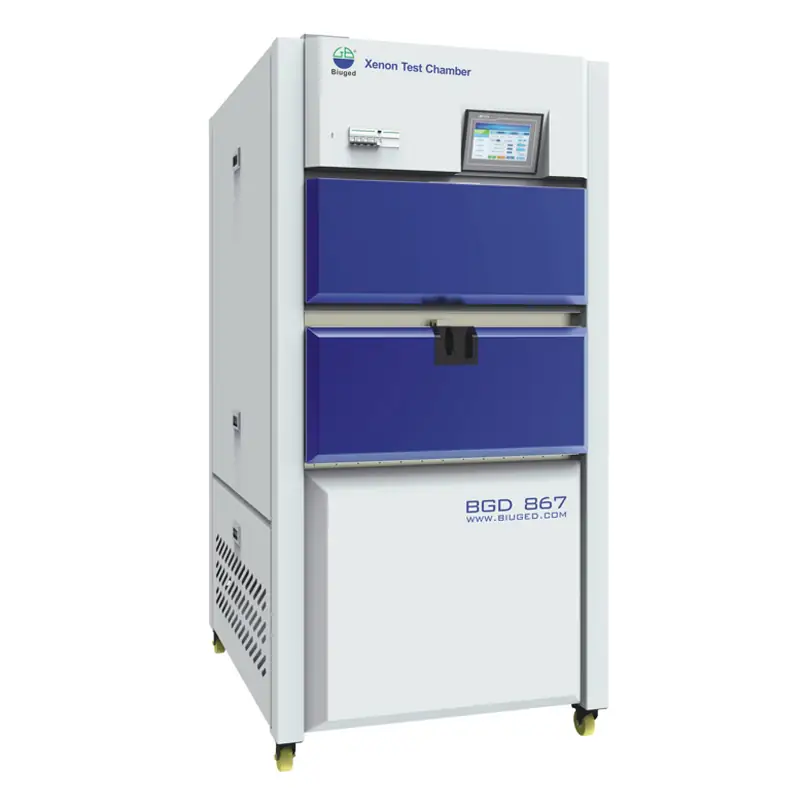
If your procedure requires xenon-arc exposure, the BIUGED xenon test chamber range provides a place to review the models available for further technical comparison.
The BGD 862 Plus features a 6.5 kW water-cooled xenon lamp and a specimen exposure area of 6,500 cm². These specifications provide useful initial points for checking chamber capacity and light-source design. They do not, by themselves, establish that the model fits a particular test method. Confirm the current specification sheet, configuration, and required operating conditions with the supplier before purchase. See the BGD 862 Plus Big Xenon Test Chamber product page for the model reference.
UV chambers and climate cabinets are available from BIUGED as separate product lines. Compare those options against the light source and environmental controls specified in your test plan. For any proposed instrument, ask for a model-specific specification sheet rather than relying on a general category description.
What Should You Check Before Purchasing an Accelerated Weathering Tester?
Before placing an order, send the supplier the material type, specimen dimensions, applicable test standard, and exposure cycle. Ask the supplier to confirm in writing that the proposed configuration can meet those requirements.
- Which standard or test method is the proposed configuration intended to support?
- Which lamp, filter, irradiance control, and environmental functions are included?
- What specimen sizes and quantities can be accommodated in the working area?
- What calibration, maintenance, consumable, and utility requirements apply?
- What documentation, operator guidance, warranty terms, and service arrangements are available?
If the test method is undecided, discuss the evaluation goal with your technical team first. A clear plan makes quotations easier to compare and helps surface missing requirements.
Conclusion
Choosing an accelerated weathering tester starts with the material, the damage being evaluated, and the applicable test method. A UV test chamber is designed for fluorescent-UV exposure, a xenon weathering chamber is used for specified xenon-arc exposure, and a climate cabinet focuses on temperature and humidity control.
Compare the required light source, filters, irradiance measurement, temperature and humidity controls, moisture functions, and specimen capacity. For BIUGED’s BGD 862 Plus, the online listing identifies a 6.5 kW water-cooled xenon lamp and a 6,500 cm² exposure area; other model details should be checked against the current technical documentation. Matching confirmed specifications to the intended procedure is a practical way to narrow the options.
