
Weathering evaluation requires careful planning before a laboratory selects a large testing system. Different materials may react differently under light exposure, heat, moisture, and long-term environmental simulation. For coating, plastic, and automotive material companies, the selection process should focus on test conditions, operating requirements, and future application needs.
A suitable weathering system is not only about chamber size. Buyers should review lamp performance, filtration methods, exposure area, standard compatibility, data management, service support, and lifecycle cost. These factors help laboratories build testing procedures that match their research and quality control goals.
Reviewing Lamp Systems and Exposure Conditions
The lamp system is one of the key parts of weathering equipment. Xenon lamps are commonly used because they can simulate parts of natural sunlight through controlled laboratory exposure. When evaluating a xenon arc test chamber, buyers should review lamp type, operating stability, and maintenance requirements.
Filtration is another important point during equipment selection. Different filters influence the light spectrum received by samples. Laboratories need to choose suitable configurations based on material type, testing purpose, and related standards.
The exposure area also affects testing efficiency. Large panels or multiple samples may require more space during evaluation. A suitable chamber design allows laboratories to arrange specimens properly while maintaining consistent exposure conditions.
Comparing Standards and Testing Functions
Weathering studies usually follow specific testing standards. Buyers should confirm whether equipment supports the required methods for their industries. Coating manufacturers, automotive suppliers, and testing organizations may have different evaluation procedures depending on their products.
A professional xenon arc weathering test chamber should provide controlled exposure settings for light, temperature, and moisture conditions. These parameters help users create repeatable testing programs and compare material changes over different stages.
Besides basic exposure functions, users should also consider monitoring and control systems. Accurate parameter management allows technicians to record test conditions and review results more effectively during product development or quality inspection.
Considering Sample Capacity and Equipment Design
Sample mounting affects exposure uniformity during weathering tests. If samples are arranged incorrectly, different positions may receive different exposure conditions. A practical rack structure helps laboratories organize specimens and maintain stable testing procedures.
Large chambers are often selected by companies handling various sample sizes. Automotive parts, coating panels, and plastic materials may have different shapes and dimensions, so flexible sample arrangements are valuable for daily laboratory work.
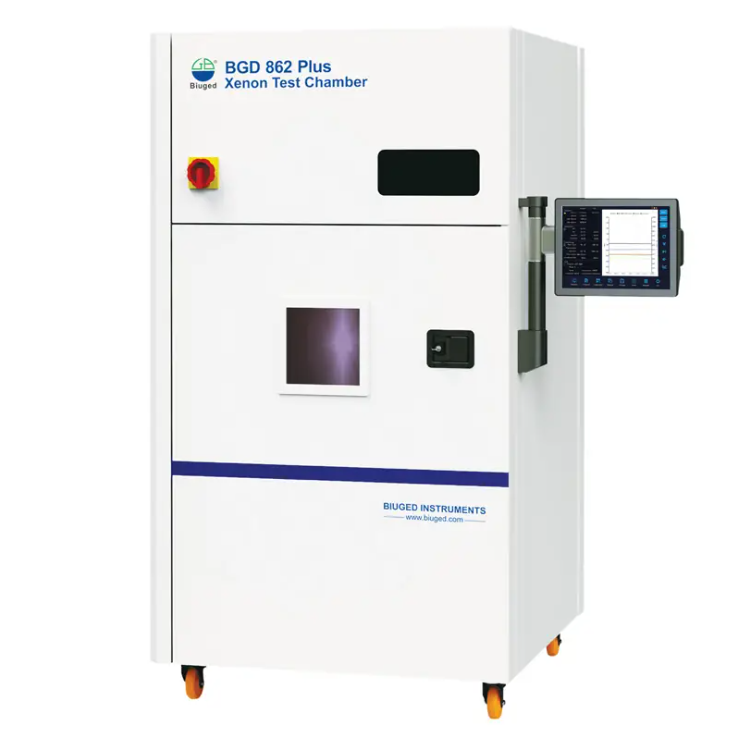
Our BGD 862 Plus is designed as a multifunction large xenon light accelerated weathering tester. It uses one 6.5KW water-cooling xenon lamp and provides a 6,500cm² exposure area. The automatic rotating drum-type sample rack with three floors helps improve exposure uniformity across specimens.
Evaluating Data Management and Operation Needs
Modern laboratories pay more attention to test records and data management. During equipment selection, buyers should consider whether the system can support clear documentation of exposure conditions, test cycles, and sample information.
A xenon arc test chamber with suitable monitoring functions can help teams organize testing procedures more efficiently. Data records and export functions are useful when laboratories need to compare different materials or review previous test projects. By exporting testing information, including exposure conditions, operating parameters, and evaluation records, users can improve data sharing between departments and maintain clearer testing documentation.
Operation convenience is also related to daily productivity. Equipment settings, sample installation, and routine maintenance should be easy for operators to understand. Training and technical support can help users establish stable testing practices.
Balancing Service Support and Lifecycle Cost
The initial purchase price is only one part of equipment evaluation. Laboratories also need to consider lamp replacement, maintenance, calibration, technical support, and long-term operating requirements.
A reliable supplier should provide support throughout the equipment lifecycle. This includes installation guidance, operation assistance, and technical communication when users adjust testing procedures.
BIUGED INSTRUMENTS develops precision testing instruments for coatings, inks, and related material industries. With our own R&D and manufacturing capabilities, we design and produce laboratory equipment for weathering, corrosion, and coating performance evaluation. Besides standard testing instruments, we also support customized solutions and OEM cooperation according to different application requirements, including equipment configuration, functional adjustments, and workflow considerations. Our experience covers material evaluation needs where data consistency and testing processes are important.
Selecting a Chamber Based on Application Goals
Different industries have different priorities when selecting weathering equipment. Coating companies may focus on color change and surface performance, while automotive companies may pay more attention to durability under environmental exposure.
Before purchasing a xenon arc weathering test chamber, buyers should review sample types, testing standards, exposure conditions, and future application plans. This helps laboratories select equipment that fits their actual workflow instead of focusing only on individual specifications.
The BGD 862 Plus meets international xenon testing standards and is equipped with a USA brand xenon arc lamp, filter, and related components. Its design supports stable operating parameters and repeatable test results for professional users.
Building a Practical Weathering Test Strategy
Choosing large weathering equipment requires a complete view of testing requirements. Lamp systems, filtration, exposure capacity, standards, data records, and service planning all influence the final testing experience.
For laboratories working with coatings, plastics, and automotive materials, a well-planned testing process supports better material evaluation. Equipment selection should connect technical functions with real application needs.
A complete weathering evaluation system combines suitable equipment, controlled testing conditions, and effective data management. By considering technical requirements, application goals, and supplier capabilities during selection, laboratories can establish testing processes that support long-term research and quality control activities.
